

 CN
CN

 Back
Back 

I. Operating Characteristics and Technical Challenges of Alumina Production.
Alumina production utilizes the Bayer process, a long and complex industrial cycle where different
stages place significantly different demands on level measurement instruments. The primary measurement scenarios
can be categorized into four main areas:
1.1 Digestion Process
Operating Characteristics: High temperatures (up to 260°C), high pressure, and strong alkalinity (NaOH concentration of 180–220 g/L). The medium is a mixed slurry of sodium aluminate solution and ore.
Measurement Challenges:
Extreme requirements for instrument structure and sealing due to high temperature and pressure.
Antenna materials must be highly corrosion-resistant to withstand strong alkali.
Solid particles in the slurry may cause scaling on the antenna surface
1.2 Settling and Separation Process
Operating Characteristics: Large-diameter settling tanks (up to 20m) with moderate height. A stable foam layer (5–15 cm thick) is present on the surface, and the tank is equipped with a rotating rake for agitation.
Measurement Challenges:
The foam layer scatters and attenuates radar signals, which is the primary cause of signal loss.
The slow rotation of the rake can be misidentified by the radar as level changes.
Complex internal structures (overflow weirs, central feeding pipes) generate false echoes.
1.3 Decomposition Process
Operating Characteristics: Large-scale decomposition tank groups containing aluminum hydroxide suspension with a stable, fine foam layer and internal stirrers.
Measurement Challenges:
Similar foam penetration issues as the settling tank, but with finer foam.
High-speed rotation of stirrer blades produces strong interference echoes.
Aluminum hydroxide crystals easily adhere to the antenna surface.
1.4 Calcination and Finished Product Storage
Operating Characteristics:
Alumina powder silos characterized by high dust levels, a large angle of repose (approx. 30°–40°), and limited headspace.
Measurement Challenges:
High dust levels attenuate radar signals.
Uneven powder surfaces lead to scattered echo intensity.
Material buildup is common, requiring self-cleaning capabilities.
II.
Analysis of Key Technical Indicators for Selection
2.1 Frequency Selection: 80GHz vs. 26GHz
The effectiveness of radar level measurement is closely tied to its operating frequency.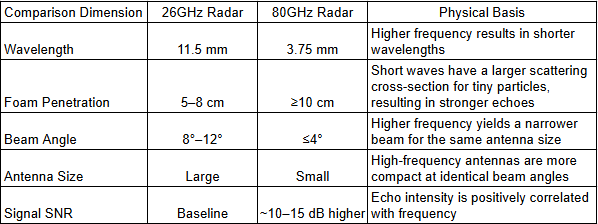
Engineering Conclusion: For scenarios with stable foam layers, such as settling and decomposition tanks, 80GHz radar penetration is significantly superior to 26GHz, effectively solving the "signal loss" problem.
2.2 Accuracy vs. Stability
While mainstream radar accuracy reaches ±2 mm, stability (no data jumps or signal loss) is more critical in alumina production than absolute accuracy to prevent false interlocking or unnecessary manual intervention.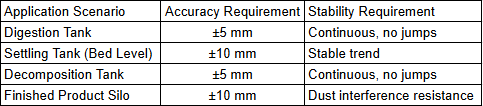
2.3 False Echo Suppression
Complex internal structures like stirrer blades, heating coils, and material buildup generate interference.
Hardware Suppression: Uses an extremely narrow beam angle (≤4°) to physically avoid obstacles.
Software Suppression: Stores a false echo curve when the tank is empty to automatically filter interference during operation.
2.4 Installation and Maintenance
Wireless Bluetooth debugging via mobile apps allows technicians to configure parameters from the ground.
This improves efficiency by over 70%, avoids the risks of working at heights, and reduces damage to seals.
III.
Shengke Electronics 80GHz Radar Technical Specifications
The U series 80GHz radar level transmitters from Shengke Electronics are specifically developed for complex industrial environments.
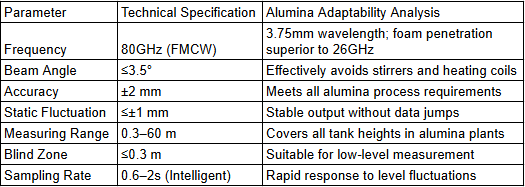
Recommended Model Configurations
Digestion (U5-H Series): Features high-temp isolation and PTFE seals; resists 300°C and strong alkali.
Settling/Decomposition(U5 Series): 80GHz high frequency with intelligent echo locking to penetrate foam and suppress rake interference.
Finished Product Silos (U5-D Series): High SNR design specifically for high-dust environments.
Slurry Tanks (U5 Series): Fully sealed PTFE antenna to prevent scaling and resist erosion.
IV.
Application Case Analysis
4.1 Slurry Tank Foam Penetration (Sanmenxia Aluminum)
Condition: 32m high tank with high-speed stirring and 10–15cm stable foam.
Problem: Previous 26GHz radar suffered frequent signal loss due to poor foam penetration.
Solution: Replaced with Shengke U5 Series 80GHz radar. The ≤3.5° beam angle concentrated energy to penetrate foam while the algorithm filtered stirrer interference.
Result: Continuous operation with zero signal loss and stable data.
4.2 Full Process Application (Guangxi Alumina Project)
Scope: 2 million tons/year production line covering raw materials, digestion, settling, decomposition, and calcination.
Application: Batch deployment of U5 series 80GHz radar across the entire plant.
Outcome: Maintenance cycles extended to annual intervals, signal jumps were eliminated, and Bluetooth debugging reduced per-unit configuration time from 2 hours to 30 minutes.
V. Selection Recommendations and Standards
| Application Scenario | Recommended Frequency | Recommended Beam Angle | Primary Basis |
| Digestion Tank | 26GHz or 80GHz | ≤8° | High temp is the main factor; frequency is secondary |
| Settling Tank | 80GHz | ≤4° | Foam penetration and rake interference |
| Decomposition Tank | 80GHz | ≤4° | Fine foam and high-speed stirrer suppression |
| Finished Silos | 80GHz | ≤4° | High dust penetration and surface focusing |
Core Technical Requirements:
Stability: Continuous operation without signal loss is prioritized over absolute precision.
Debugging: Bluetooth wireless debugging is preferred to reduce high-altitude safety risks.
Durability: Fully sealed PTFE antennas (IP67) with surge protection (≥1000V) are essential for outdoor, alkaline, and high-dust environments.
VI. Conclusion
In the alumina industry, 80GHz high-frequency radar offers clear advantages in foam penetration and interference suppression over traditional 26GHz models. Shengke Electronics' U series meets and exceeds these industry standards with its narrow beam angles, high precision, and user-friendly Bluetooth maintenance, as proven by successful large-scale deployments in major Chinese alumina refineries.
From the above, we can say that SKE Shengke 80GHz radar level transmitter series is an ideal alternative of VEGA Level Instruments.

