

 CN
CN

 Back
Back 

Project Overview
Recently, Shengke Electronics' SK-WK- the ultrasonic non-invasive level switches were successfully commissioned on the caustic wash and oxidation towers at a nuclear power wastewater station in East China. Several units are now responsible for the precise monitoring and alarming of high and low liquid levels, while integrating with the PLC control system to automate filling and draining processes.
Technical Features
Perfectly Suited for Harsh Nuclear Power Conditions, Ensuring Absolute Safety!
Shengke’s SK-WK ultrasonic non-invasive level switches are perfectly suited for the harsh operating conditions of nuclear power plants. The SK-WK® sensor probe utilizes an external clamp-on installation, eliminating the need for drilling or "extremely hot work" on the tower body. Because the sensor does not come into contact with the strongly alkaline and oxidizing media, leakage and corrosion risks are fundamentally eliminated. Having passed rigorous environmental adaptability testing, the equipment operates stably in high-temperature, high-humidity, and highly corrosive environments, fulfilling the core nuclear power requirements for maximum safety and reliability.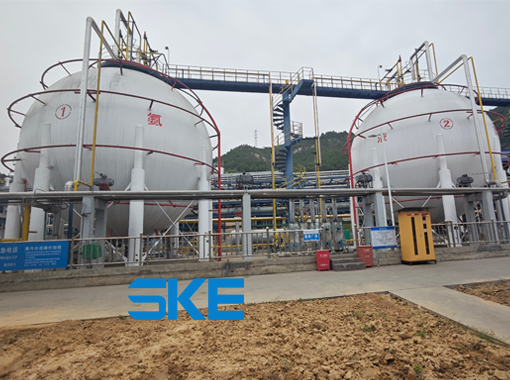
Working Principle
Operating on the principle of ultrasonic reflection, the SK-WK® penetrates the vessel wall to accurately capture level changes and deliver precise high and low level alarms. Its advanced anti-interference algorithm effectively filters out disturbances from bubbles and foam inside the tower. This ensures a stable and reliable signal, providing accurate data support for level control in caustic wash and oxidation reactions, while effectively preventing process fluctuations and safety risks caused by level anomalies.
Corporate Success & Compatibility
With over 13 years of specialization in the level measurement field, Shengke's SK-WK® series has been successfully deployed in multiple nuclear power projects and seamlessly adapts to sectors like petrochemicals, food/pharma, and marine engineering. The successful implementation at the Qinshan Nuclear Power Plant once again validates the outstanding performance of Shengke Electronics' SK-WK® in demanding industrial environments.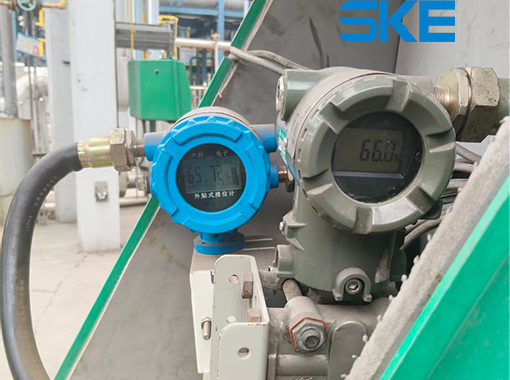
The Challenges: Overcoming the Limitations of Traditional Liquid Ammonia Measurement.
Before partnering with Shengke, China Coal Chemical struggled with three critical issues in their liquid ammonia storage:
The Corrosion Trap: Harsh liquid ammonia quickly degraded contact-type sensors, forcing frequent repairs and compromising data accuracy.
The "Gap" Problem: Standard flat probes couldn't "hug" the curved surface of spherical tanks. This poor fit weakened the signal, while ammonia foam caused constant false alarms and unreliable readings.
The Safety Gamble: Every hole drilled for a traditional sensor was a potential leak point. In high-pressure environments, even a minor seal failure involving toxic ammonia poses an unacceptable safety risk.
ShengKe Technology Electronics External-Mount Liquid Level Gauge/Transmitter Technical Solution
The ShengKe Technology Electronics external-mount (non-invasive) liquid level transmitter is based on the sonar ranging principle. A dedicated ultrasonic probe is externally attached to the bottom of the storage tank's outer wall.
The probe emits ultrasonic waves that penetrate the tank wall, propagate through the liquid inside the tank, reflect off the liquid surface, and are then received by the probe. The liquid level height is calculated using a proprietary algorithm. This solution achieves true non-contact measurement — the probe is completely isolated from the measured medium by the tank wall. Installation requires no openings on the tank body and can be completed without shutting down production or emptying the tank. The instrument is equipped with a high-precision built-in temperature sensor, which can acquire the real-time temperature of the liquid ammonia inside the tank. It then retrieves the corresponding speed of sound for liquid ammonia at that specific temperature from the ShengKe Technology Electronics database, enabling accurate temperature compensation and calibration. This fundamentally ensures measurement accuracy and eliminates the impact of temperature fluctuations on the speed of sound. Measurement data is transmitted remotely to the central control DCS system via 4-20mA or RS-485 interfaces, supporting remote centralized monitoring and real-time alarms. The device has obtained SIL3 functional safety certification, with a false alarm rate of less than 0.2% under complex operating conditions.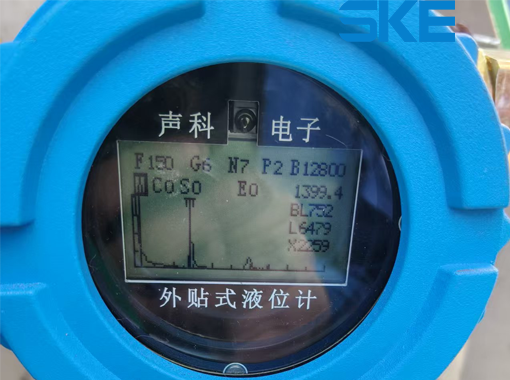
The Core Edge: Specialized Sloped Probes for Spherical Vessels
What sets Shengke Electronics apart in spherical tank measurement? It's our innovative sloped probe—the only sensor designed to truly "hug" a curved tank.
* Perfect Fit, Superior Signal: Unlike flat sensors that leave gaps on curved walls, our precision-machined sloped probes provide maximum surface contact. * This eliminate signal loss and boosts signal strength by more than 30%. You get a clear, stable reading every time.
* Smart Anti-Interference: Liquid ammonia foam and evaporation can confuse standard sensors.
* Our unique 60-degree angle bypasses these internal disturbances, delivering millimeter-level accuracy where others fail. With advanced copper shielding, we filter out the noise so you only see the data that matters.
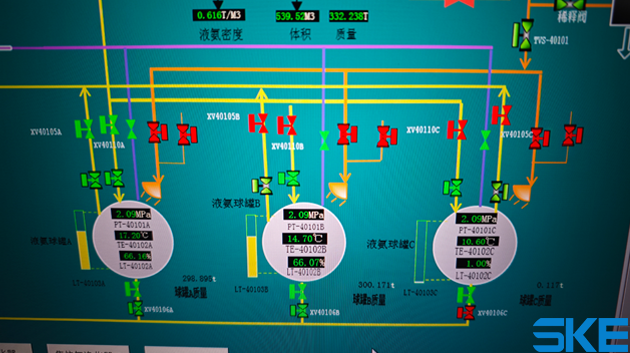
Fast, Secure, and Tool-Free: No drilling. No welding. No downtime. Our probes snap onto the tank bottom using high-strength magnets and specialized couplant. Because the probe matches the tank's curve perfectly, it stays locked in place—even under heavy vibration—offering a lifetime of maintenance-free performance.
Performance Summary: China Coal Chemical Liquid Ammonia Project
Stability: Continuous stable operation since commissioning.
Precision: Measurement error within ±0.2% (Superior to industry standard).
Efficiency: Lower failure rates and extended maintenance intervals; reduced O&M costs.
Safety: Non-contact, zero-leakage design eliminates ammonia exposure risks.
Summary: Shengke Electronics utilized its proprietary spherical-tank slope probe to achieve a transition from contact to non-contact measurement. The design ensures a perfect fit to the tank curvature, providing high signal integrity and reliability. This technology serves as a domestic benchmark for ultrasonic level measurement, enhancing essential safety in hazardous chemical logistics.

