

 CN
CN

 Back
Back 

To ensure the long-term stable, accurate, and reliable operation of the Shengke Electronics 80 GHz radar level transmitter and to fully leverage its advantages in high-frequency radar ranging and high-precision measurement, routine condition monitoring and fault diagnosis must be carried out on a regular basis. This document systematically summarizes the key monitoring parameters, built-in diagnostic functions, echo curve analysis methods, and fault code handling procedures for the 80 GHz radar level transmitter, providing a standardized technical reference for daily operation and maintenance, condition assessment, and fault troubleshooting.
I. Core Continuous Monitoring Parameters
The core diagnostic parameters of the Shengke Electronics 80 GHz radar level transmitter can be read via the onboard display or communication interface. The device relies on 80 GHz high-frequency radar signals to perform measurements and is highly sensitive to signal quality and operating conditions. Continuously monitoring parameter values and their trends enables early identification of potential equipment issues, preventing measurement inaccuracies and signal anomalies. The normal ranges and monitoring significance of each key parameter are as follows:
Echo Amplitude refers to the signal amplitude of the echo reflected from the actual process level. Matched to the high-frequency measurement characteristics of the Shengke Electronics 80 GHz device, the normal value should exceed 20 dB in applications involving media with high dielectric constants. A higher echo amplitude indicates better signal quality and greater assurance of high-frequency measurement accuracy. A low value is prone to causing measurement fluctuation and signal loss-of-lock, undermining the device's high-frequency precision measurement capability.
Echo Threshold is the minimum signal level required for the device to recognize a valid echo. The default value is 12 dB and can be manually adjusted to suit various measurement scenarios. Setting the threshold too high will filter out weak but genuine level signals, resulting in missing measurement data. Setting it too low risks admitting environmental noise, causing measurement interference and data distortion, and negating the core advantages of 80 GHz radar in anti-interference and high-precision measurement.
Gain is the amplification factor applied to the received signal. It supports automatic adaptation or manual configuration in line with the signal reception mechanism of the Shengke Electronics 80 GHz radar. The gain value directly reflects on-site signal conditions. If the gain remains persistently elevated, this typically indicates abnormal signal reception caused by antenna contamination or installation misalignment, and timely maintenance investigation is required.
Internal Temperature refers to the operating temperature of the electronic components within the Shengke Electronics 80 GHz radar level transmitter. The standard operating range is −40 °C to +80 °C. When the temperature approaches or exceeds the limit, the device triggers a Bit7 alarm, the RF module ceases operation, and the instrument halts normal measurement to prevent equipment damage and measurement errors under extreme temperature conditions.
Signal Quality (SNR — Signal-to-Noise Ratio) is the key indicator for comprehensively evaluating the quality of the 80 GHz radar signal. There is no fixed standard value. A higher SNR with smaller fluctuation indicates better high-frequency signal stability and more accurate measurement data. Larger fluctuations suggest the presence of electromagnetic interference, equipment vibration, or other adverse on-site conditions, which may degrade the device's high-frequency measurement performance.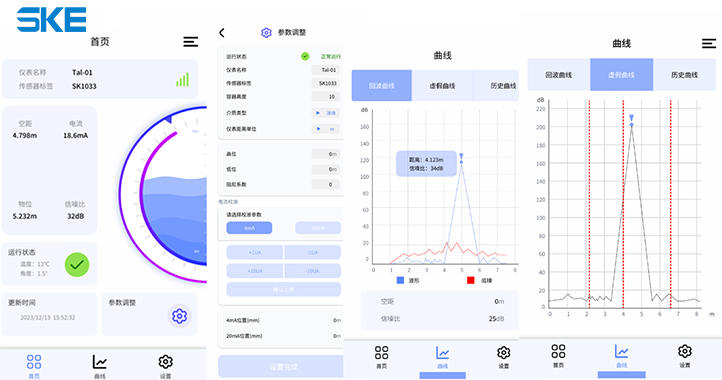
II. How to Use the Built-In Diagnostic Functions
The Shengke Electronics 80 GHz radar level transmitter includes professional built-in diagnostic tools, optimized for the characteristics of high-frequency radar measurement. These tools allow operators to visually inspect device operating status and verify the integrity of the high-frequency signal chain, helping maintenance personnel quickly locate problems and ensure stable operation. The core functions are as follows:
Waveform Viewing Function: Navigate to [Diagnostic Settings] → [View Waveform] on the instrument. Operators can switch between the real-time echo curve, the learned false-echo curve, and the historical level trend curve. This provides precise visibility into the 80 GHz radar signal reflection status and level measurement operating conditions, enabling rapid identification of high-frequency signal anomalies.
Simulation Verification Function: Enable the current simulation function via [Diagnostic Settings] → [Simulation]. This allows independent verification of the transmission accuracy and operational validity of the complete high-frequency signal chain of the Shengke Electronics 80 GHz radar level transmitter, without depending on actual process level conditions. It facilitates rapid diagnosis of signal chain faults and ensures that measurement accuracy meets requirements.
III. Key Points for Echo Curve Analysis
The echo curve is the primary basis for signal condition analysis and anomaly identification in the Shengke Electronics 80 GHz radar level transmitter. It provides a direct visual representation of the on-site signal reflection characteristics of the 80 GHz high-frequency radar and is well-suited to the device's high-precision measurement requirements. The interpretation of each dimension is as follows:
The horizontal axis of the curve represents the measured distance in meters or feet, with the installation position of the Shengke Electronics 80 GHz radar level transmitter as the starting point. The vertical axis represents signal strength in decibels (dB), used to characterize the strength of the high-frequency signal.
True Level Echo: The prominent peak appearing in the curve. The horizontal coordinate of this peak corresponds to the actual level position and is the valid core signal used by the 80 GHz radar to calculate the process level accurately.
False Echoes: Any anomalous peaks other than the true level echo, primarily generated by reflections from tank walls and internal structures. These are invalid interference signals that can disrupt 80 GHz high-frequency signal recognition and compromise measurement accuracy.
Noise Signal: Minor, irregular fluctuations in the curve caused by on-site electromagnetic interference, equipment vibration, or tank vibration. These reduce the stability of the 80 GHz radar signal and have a minor adverse effect on measurement accuracy.
Signal Threshold: The reference criterion for distinguishing valid echoes from noise signals. Only signals exceeding this threshold are recognized, processed, and output as measurement data by the device. This is the critical condition for ensuring the high-precision and stable measurement performance of the Shengke Electronics 80 GHz radar level transmitter.
IV. Fault Code Handling Procedure
When the Shengke Electronics 80 GHz radar level transmitter triggers a fault alarm and displays a fault code, a standardized step-by-step procedure must be followed to efficiently investigate and resolve the anomaly, and to restore the device's high-frequency precision measurement performance as quickly as possible. The specific procedure is as follows:
Record the complete fault code displayed by the device (e.g., E40), ensuring the fault information is accurately captured.
Refer to the Shengke Electronics 80 GHz radar level transmitter fault code manual to make a preliminary assessment of the fault type and likely cause.
Consult Section 9.7 of the instruction manual for preliminary response measures, and carry out basic inspections and corrective actions.
If the preliminary investigation fails to clear the fault, compile complete documentation — including the instrument model, serial number, fault description, and echo curve images — and contact the manufacturer's technical support team for professional diagnosis and repair.

