

 CN
CN

 Back
Back 

Different scenarios, different logic
There's no shortage of spots in a power plant where non-contact (clamp-on) level gauges make sense — but the media properties and the specific way the old solution failed differ from one point to the next. Rather than making a blanket claim that clamp-on gauges "solve level measurement problems in power plants," it's more useful to walk through six typical scenarios one at a time: what the actual pain point is, and exactly which part of it the clamp-on approach addresses.
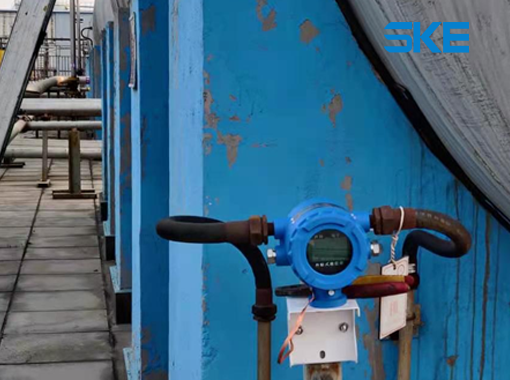
Desulfurization wastewater tanks: corrosive media
Desulfurization wastewater contains gypsum particles, chloride ions, and heavy metal precipitates — it's mildly acidic with high suspended solids. Float switches and hydrostatic (submersible) probes left soaking in this kind of medium quickly build up scale and gypsum crystals. Floats get stuck; submersible probe diaphragms get coated, causing zero drift. That's the direct reason instruments at these points get swapped out so often.
A clamp-on sensor mounts on the outside of the tank wall and never touches the medium at all, sidestepping scaling and probe corrosion at the root. Its accuracy depends only on whether the ultrasonic signal can penetrate the tank wall and identify the acoustic impedance interface — not on how clean the probe surface is. For this kind of medium, the value of the clamp-on approach isn't "more accurate measurement" — it's not having to worry about replacing probes constantly.
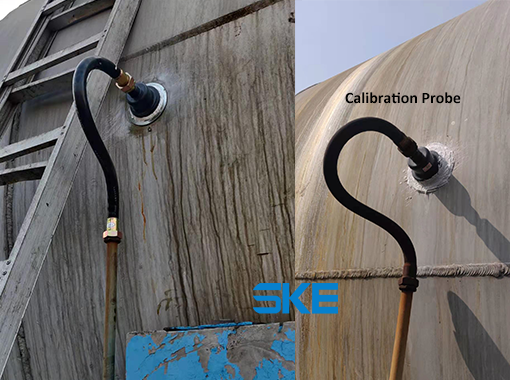
Ash slurry tanks: probe protection against abrasive media
The medium in ash removal system slurry tanks is heavily particulate and highly abrasive. Contact-type probes with mechanical parts — floats, paddle switches — wear out fast under constant erosion, which can lead to false interlock trips or delayed alarms. Since clamp-on sensors don't touch the medium, abrasion is essentially a non-issue, and it also eliminates the routine manual cleaning that comes with probes getting jammed.
Fuel oil tank farms: no penetration, no shutdown required
Fuel oil tank farms in power plants (ignition oil, fuel oil storage tanks) hold flammable media, and the tanks themselves are governed by fire-safety and explosion-protection codes. Drilling into the tank to install a sensor means going through hot-work permits and production shutdown/isolation procedures — a costly, time-consuming process. Clamp-on gauges require no penetration and can be installed directly on tanks that are in service with liquid still inside, making them especially well-suited for retrofitting older fuel tank farms or for emergency replacement when an existing instrument fails.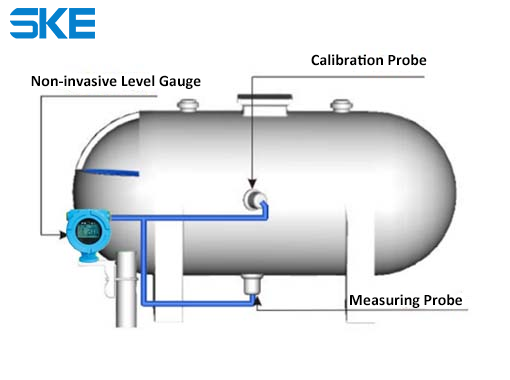
Closed water tanks, condensate tanks: routine points on sealed vessels
These tanks are typically sealed and either pressurized or under vacuum. Traditional approaches mean either drilling for a float or submersible instrument, or mounting radar through a top flange. For older tanks that were never designed with a suitable flange interface, clamp-on gauges offer a way to add instrumentation without modifying the vessel structure — provided the liquid is relatively clean and the tank wall material is uniform.
Chemical dosing tanks (sodium hypochlorite, hydrochloric acid, sodium hydroxide storage)
Dosing tanks in chemical water treatment systems are highly corrosive environments. Contact-type sensors demand very stringent material requirements — even with corrosion-resistant alloys or PTFE-lined construction, the probe body still carries corrosion risk over the long run. Clamp-on gauges eliminate direct contact between sensor and medium entirely, making them a relatively safe choice for strongly corrosive storage tanks — provided the tank wall material (e.g., plastic-lined or fiberglass) transmits ultrasonic signals well, which is worth verifying carefully during selection.
Central air conditioning chilled water tanks, fire water reservoirs: the comfort zone for clamp-on
These points typically involve relatively clean media and don't demand high accuracy. Installation is simple and maintenance costs are low, making clamp-on gauges a cost-effective choice for auxiliary system level monitoring — particularly useful where there was previously no measurement method at all and major piping modifications aren't desirable.
Six scenarios side by side
| Scenario | Medium characteristics | Pain point with original solution | Clamp-on solution |
|---|---|---|---|
| Desulfurization wastewater tank | Crystalline salts, suspended solids, mildly acidic | Float/submersible probes scale and jam | Isolated measurement, long maintenance-free intervals |
| Ash slurry tank | Highly particulate, highly abrasive | Mechanical parts wear quickly | No contact, avoids abrasion |
| Fuel oil tank farm | Flammable medium, strict fire-safety controls | Penetration/modification process is complex | No penetration needed, can install while tank is in service |
| Closed/condensate tank | Sealed, pressurized or vacuum | Lacks suitable installation interface | Can be added without modifying vessel structure |
| Chemical dosing tank | Strongly corrosive medium | High corrosion risk for contact-type materials | Sensor fully isolated from medium |
| Chilled water/fire water tank | Relatively clean medium | Lacks cost-effective measurement method | Simple installation, cost-effective |
Looking at all six scenarios together, the pattern is fairly clear: SKE's clamp-on gauges really shine at points where drilling is inconvenient and maintenance costs are high — not as a universal replacement for every level measurement need. Whether a given point is actually a good fit still comes down to tank wall material, thickness, and temperature range.

