

 CN
CN

 Back
Back 

In high-risk industrial sectors such as petrochemicals, fine chemicals, and LPG storage and transportation, the safety and accuracy of level measurement have always been central concerns. Traditional level gauges typically require openings to be cut into storage tanks during installation, introducing not only leak risks but also the operational challenges of production downtime, complex retrofitting, and difficult maintenance. The emergence of clamp-on level gauges offers a fundamentally new solution to these problems.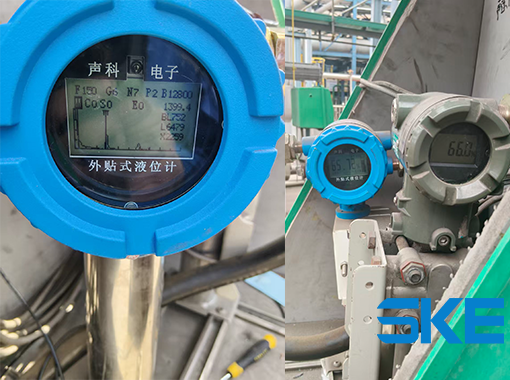
SKE (Shaanxi Shengke Electronic Technology Co., Ltd.) is a high-tech enterprise focused on level instrumentation, headquartered in the Xi'an High-Tech Industrial Development Zone. The company integrates R&D, manufacturing, sales, and service under one roof. Its core R&D team brings 15 years of experience in level measurement, with products deployed worldwide. SKE has been qualified as a materials supplier for both PetroChina and Sinopec. SKE's independently developed external clamp-on ultrasonic level gauge (SK-WY series) operates on sonar ranging principles: a dedicated ultrasonic transducer is attached to the outside of the tank bottom, emitting ultrasonic waves that penetrate the tank wall, travel through the liquid inside, reflect off the liquid surface, and return to be received by the same transducer. A proprietary algorithm then calculates the liquid level. This design achieves truly non-invasive measurement — the transducer is completely separated from the measured medium by the tank wall, with no openings required in the vessel.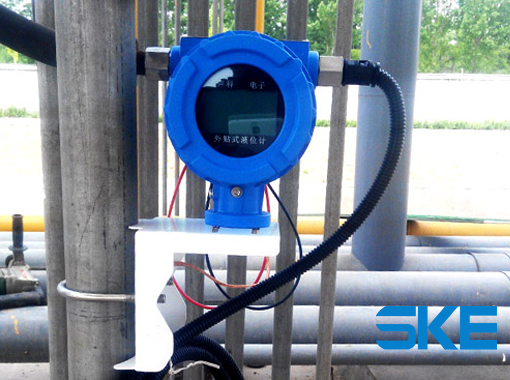
I. Magnetic Attachment: How Is Magnetic Adhesion Ensured?
The measurement transducer of the clamp-on level gauge uses neodymium magnets (NdFeB alloy) — the strongest permanent magnetic material in commercial use today, characterized by high energy density and high coercivity. Where tank corrosion may reduce magnetic adhesion, the following steps can restore and maintain a reliable magnetic hold:
1. Surface preparation before installation
Before installation, thoroughly remove all rust, grease, loose old paint, and other contaminants from the installation area on the outer tank wall. Grind the area into a flat circular surface matching the transducer face dimensions. The prepared surface should be rust-free, smooth, and bright, ensuring full contact between the transducer and the tank wall.
2. Apply coupling agent
After surface preparation, apply a thin, even layer of dedicated coupling agent (silicone grease) to the working face of the transducer. The coupling agent serves three essential functions: eliminating air gaps between the transducer and tank wall, enhancing magnetic adhesion, and ensuring stable acoustic signal transmission.
II. Sealing Material Selection
Where sealing of the joint between the transducer and tank wall is required, apply a uniform bead of waterproof sealant around the outer edge of the transducer after installation and once adhesion is confirmed. Once cured, this forms a reliable sealing layer. For ferromagnetic tanks, the transducer adheres directly by magnetic force. For non-magnetic materials such as glass or stainless steel, adhesive bonding, welding, or bracket mounting can be used instead.
III. Service Life and Measurement Range
One of the key advantages of the clamp-on level gauge is its long design life. Because the measurement process involves no moving mechanical parts, wear and corrosion are minimal. Under normal operating conditions, service life reaches 8–10 years.
The standard measurement range is 0–30 metres. SKE offers multiple range options (3 m, 5 m, 10 m, 20 m, 30 m, etc.) to match actual tank height. Measurement accuracy reaches 0.1% FS to 0.5% FS.
IV. Applicable Tank Materials
The clamp-on level gauge is compatible with all rigid tank materials, including carbon steel, 16MnR, 304/316 stainless steel, fibre-reinforced plastic (FRP), and hard rubber. SKE's external clamp-on level gauges are widely applied in demanding and complex operating environments, including LPG storage tanks, liquid ammonia spherical tanks, refrigerant storage vessels, and highly corrosive media tanks.
V. Three-Way Comparison: Clamp-On vs. Ultrasonic (Top-Mount) vs. Radar
| Comparison Item | Clamp-On Level Gauge (SKE) | Top-Mount Ultrasonic | Radar Level Gauge |
|---|---|---|---|
| Measurement Principle | Ultrasonic waves penetrate tank wall → reflect off liquid surface → received by same transducer | Air-conducted ultrasonic waves reflect off liquid surface | Electromagnetic waves propagate through air, reflect off liquid surface |
| Tank Opening Required | No opening, no hot work, no production shutdown; no penetrations or leak points | Tank top must be opened; flange-mounted | Installed through opening at tank top |
| Contact with Medium | No contact with liquid whatsoever; zero risk of corrosion, scaling, or blocked transducer | Transducer suspended above liquid; tank opening exposed to vapor phase | Antenna does not contact medium |
| Advantages | ① Fully non-invasive; no opening or hot work; installation and maintenance without production shutdown ② No contact with medium; ideal for highly corrosive, toxic, high-pressure, and flammable/explosive substances ③ Unaffected by changes in dielectric constant, density, or pressure ④ No leak points; environmentally safe | ① Simple structure; easy to install ② Convenient installation and maintenance | ① High measurement accuracy (up to ±1 mm); large range ② Fast response (≤0.5 s) |
| Disadvantages | ① Not suitable for suspensions, emulsions, or excessively viscous media ② Subject to limitations based on tank wall material and thickness | Significantly affected by ambient conditions | ① Media with very low dielectric constant (<1.4) may be difficult to measure ② Thick foam layers can interfere with measurement ③ Requires opening at vessel top |
| Typical Applications | Toxic, highly corrosive, high-pressure vessels; flammable and explosive media level measurement | Wastewater treatment, open water tanks, groundwater wells, standard atmospheric-pressure level measurement | Refinery and petrochemical applications; high-temperature, high-pressure tanks; reactors; complex environments with steam, dust |
Quick Selection Summary
Hazardous chemical tanks, no-modification/no-penetration requirement, high-pressure or toxic media → Choose clamp-on level gauge
Ambient-temperature clean water tanks, standard atmospheric storage, budget-sensitive applications → Choose top-mount ultrasonic
Tanks with steam/foam/dust, high temperature and pressure, high-precision custody transfer → Choose radar level gauge
VI. Adhesive Mounting: Service Life and Maintenance
For non-magnetic tanks, the transducer can be fixed using adhesive. Key considerations:
1. Adhesive service life
Under correct application and normal environmental conditions, the adhesive used for transducer mounting has a service life of 8–10 years — sufficient to cover the full operational life of the clamp-on level gauge. Epoxy resin AB adhesive is recommended, offering excellent bonding strength and chemical resistance suitable for industrial transducer mounting.
2. Division of roles: adhesive vs. silicone grease
A fundamental principle must be observed:
Adhesive provides mechanical fixation, preventing the transducer from detaching from the tank wall.
Silicone grease (coupling agent) ensures stable signal transmission and must be applied to the working face of the transducer.
During installation, apply a thin layer of silicone grease to the working face (centre area) of the transducer, and use adhesive around the outer edge to secure it. The two materials must not be mixed or substituted for one another.
3. Is periodic re-adhesion required?
No periodic removal and re-adhesion is necessary, but regular inspection is recommended.
4. Installation and maintenance recommendations
Initial installation: Grind the surface flat, clean, and dry per the surface preparation requirements; apply epoxy resin AB adhesive evenly around the outer edge of the transducer; avoid disturbing during the curing period.
Periodic inspection: Include in routine equipment inspection rounds, focusing on the condition of the adhesive layer and transducer stability.
VII. Core Advantages of SKE's External Clamp-On Level Gauge
SKE's external clamp-on level gauge has become the preferred product for industrial non-invasive level measurement on the strength of the following capabilities:
Intrinsic safety: Operating voltage of 24V DC with a rated power of only 0.48W — a low-power design. The complete unit holds Ex db IIC T6 Gb explosion-proof certification, fully compatible with petrochemical hazardous area classifications.
No tank opening, no production shutdown: Installation does not affect normal tank operation. A single unit can be installed and commissioned within 2 hours.
High measurement accuracy: Built-in adaptive filtering algorithm and temperature compensation technology deliver measurement accuracy of ±0.2% FS.
Maintenance-free for service life: No consumable parts; transducer never contacts the medium, eliminating corrosion and build-up. No periodic inspection or recalibration required after installation.
Strong signal penetration: Large, high-sensitivity transducer enables signal penetration through tank walls up to 70 mm thick.
VIII. Frequently Asked Questions
1. Will heavy rust on the tank affect magnetic adhesion?
It will, but through thorough grinding to remove rust, achieving a smooth surface, and applying the dedicated coupling agent, full magnetic adhesion stability can be completely restored.
2. Does the clamp-on level gauge require periodic calibration?
Under normal operating conditions, frequent calibration is not required. An annual accuracy check as part of routine equipment inspection is sufficient.
3. Can it be installed on a tank that is currently in operation?
Yes. SKE's clamp-on level gauge supports installation without production shutdown or hot work permits. The installation process does not affect normal tank operation.
SKE — specialist manufacturer of clamp-on level gauges, delivering proven and reliable solutions for hazardous media level measurement with a focus on safety, accuracy, and simplicity.

