

 CN
CN

 Back
Back 

SKE 80GHz Radar Level Transmitters: A Power Industry Level Measurement Solution
I. Level Measurement Challenges in the Power Industry
Instrument technicians at power plants know these scenarios well: deaerator level alarms that fire intermittently, drum level gauges needing calibration every few days, transformer oil sight glasses that gradually fog over. Power generation involves many level points requiring continuous monitoring — drum water level, deaerator level, condensate tanks, desulfurization absorber slurry, transformer insulating oil, fuel oil/diesel tanks, reservoir forebay water level, and battery electrolyte. Nearly every system depends on a reliable level instrument.
Most of these measurement points are far from easy: deaerators and drums run at high steam density, high temperature, and high pressure; substations have strong electromagnetic interference; desulfurization slurry is thick and prone to scaling; some vessels have small nozzles with internal agitators and heating coils. Ultrasonic, float, and magnetic flap gauges frequently struggle in these conditions — large blind zones, false readings from steam and foam interference, and antennas too large to fit small nozzles. This is why power plants have increasingly shifted to 80GHz radar level transmitters in recent years.
II. Technical Advantages of 80GHz Radar
Higher frequency means shorter wavelength, allowing smaller antennas and narrower beams. At 80GHz, wavelength is about 3.75mm, with beam angles as narrow as roughly 4°. SKE's 80GHz radar series, its main product focus over the past two years, follows this technical approach, delivering several practical benefits:
Interference resistance: A narrow beam means less clutter reflection from agitators, heating tubes, and ladders inside vessels, significantly reducing false alarms.
Small blind zone: Near-range blind zones can be compressed to just a few centimeters, allowing measurement close to full scale even in small vessels or elevated installations.
High accuracy: ±2mm, meeting strict process control requirements.
Strong penetration: Millimeter waves penetrate steam and dust far better than low-frequency radar or ultrasonic, enabling stable operation even in steam-filled environments like deaerators and drums.
Flexible installation: Small antennas mount directly on small nozzles, making retrofits on older equipment straightforward.
III. Typical Applications in the Power Industry
In thermal power plants, deaerator level has long been a persistent problem — operating around 104°C with pressure between 0.02–0.6MPa and heavy steam interference, traditional differential pressure transmitters need frequent calibration. Following deaerator retrofits at several power plants, customers reported notably reduced calibration frequency. Drum level measurement benefits similarly; paired with PTFE or ceramic high-temperature antennas, it provides continuous, reliable measurement and serves as an important redundant safety monitoring method. Condensate tanks and drain tanks, with their limited space, also benefit clearly from small antenna designs.
In desulfurization and denitrification systems, gypsum slurry pools and absorber slurry are thick and scale-prone, and ordinary radar antennas can become coated and lose function. SKE's products use anti-adhesion antenna treatment to reduce signal attenuation caused by scaling.
For transformers and switchgear, traditional mechanical oil level gauges are vulnerable to seal aging, stuck pointers, and oil leakage risk. Switching to non-contact radar eliminates sealing concerns, and oil level data can feed directly into monitoring systems — particularly useful for unattended substations.
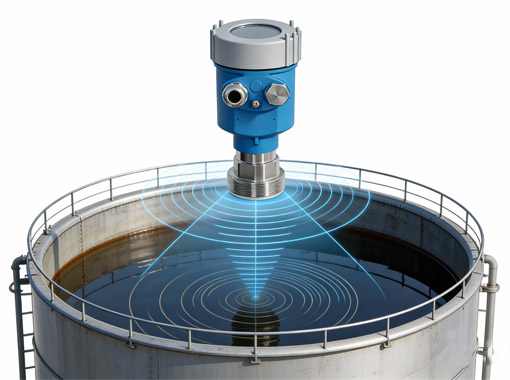
Power plant storage tanks — fuel oil tanks and emergency diesel tanks — are often tall, with ranges reaching over ten meters. SKE's 80GHz radar transmitters mount on the tank roof, with the antenna transmitting millimeter waves straight down and receiving the liquid surface echo, converting round-trip time into level — fully non-contact. The narrow beam avoids clutter from tank walls and ladders, and this advantage becomes more pronounced as tanks get taller and more crowded with internal fittings. The transmitter outputs 4-20mA or HART signals for continuous level monitoring and inventory calculation, and combined with high/low alarms, provides overflow and dry-run protection — eliminating the need for staff to climb tanks for manual measurement.
For hydropower stations, reservoir, forebay, and tailwater level monitoring involve large-range outdoor measurement where wind, waves, and icing significantly affect ultrasonic performance; 80GHz radar adapts better to these conditions. Energy storage stations' liquid cooling systems and electrolyte tanks have compact spaces, where small antenna size combined with high precision matches installation dimension requirements well.
IV. Comparison with Traditional Measurement Technologies
Under equivalent installation conditions, ultrasonic is vulnerable to steam and temperature gradients, while 80GHz radar is essentially unaffected. Compared with 26GHz low-frequency radar, the narrower beam and smaller antenna offer clearer advantages in small nozzles and obstruction-heavy vessels. Compared with magnetic flap or servo-type level gauges, non-contact measurement has no mechanically wearing parts — maintenance-free operation translates into real cost and labor savings for power plants.
V. Selection and Installation Guidelines
Explosion-proof certification comes first — transformer oil areas and fuel storage zones are classified as explosive gas environments, requiring confirmation that the product meets relevant ratings such as ExdIIBT6 or ExiaIICT6. Electromagnetic compatibility also matters, given the prevalence of VFDs and large motors in power plants — instruments need to withstand IEC 61000-series EMC testing. Antenna material should match process conditions: PTFE or ceramic antennas are more reliable for high-temperature, high-pressure applications, and flange material should account for media corrosiveness. Installation location should be near the vessel centerline where possible, avoiding inlet ports and agitation zones, with adequate distance from vessel walls to avoid edge reflection interference. On the communications side, products supporting HART and Modbus integrate more easily with plant DCS systems — SKE's 80GHz series supports these as standard, enabling direct integration with existing plant control systems.
VI. Field Results
Feedback from several thermal and hydropower customers SKE has served shows that after switching to 80GHz radar level transmitters, false alarms decreased and calibration/maintenance frequency dropped. Maintenance staff no longer need frequent trips to hard-to-access locations like deaerators and drums, and the reliability of unit operating data has also improved.
VII. Development Trends
The power industry's broader shift toward reduced or unattended staffing is a major trend, and 80GHz radar level transmitters will likely integrate more closely with wireless communication and edge computing going forward, enabling real-time diagnostics and fault prediction. SKE is exploring this direction as well, aiming to make level measurement smarter within intelligent power plants.

