

 CN
CN

 Back
Back 

I. Introduction
Radar level sensors are increasingly used in the chemical, metallurgical, and power industries for continuous level measurement. But industrial storage tanks are not clean environments — fixed structures like tank walls, agitators, coil pipes, and ladders, as well as foam,
vapor, and surface turbulence on the liquid, can all generate false echoes. If these aren't handled properly, measurements drift off, and in severe cases the control system can misfire, potentially leading to safety incidents.
80GHz radar has been a hot technology in recent years, with clear advantages in narrow beam angle and high resolution. SKE's SK-R800 series is a product of this type, using FMCW (Frequency-Modulated Continuous Wave) technology with its own approach to handling false echoes. Using this series as an example, this article looks at where false echoes come from, how to deal with them, and how to handle them on-site.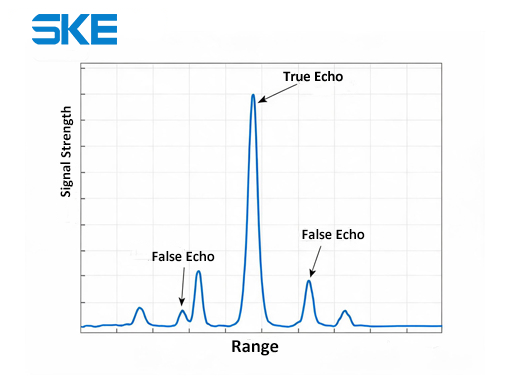
II. Causes and Effects of False Echoes
2.1 Three Main Sources
False echoes generally fall into three categories.
The first is reflection from fixed structures. Metal components inside the tank — tank walls, agitator blades, coil pipes, ladders — all reflect radar waves, creating interference peaks at fixed positions. Sometimes burrs on mounting nozzles or flange welds can also cause near-field interference.
The second relates to the medium itself. A foam layer scatters the radar wave, producing a jumble of scattered reflection signals. Vapor rising from hot liquids and suspended particles in dust likewise scatter radar waves, creating noise-level interference.
The third is installation-related. If the antenna is tilted more than 3°, the main beam goes off at an angle and is prone to hitting the tank wall or other structures. Installing too close to the tank wall, or directly above the feed inlet or agitator, also adds significant interference.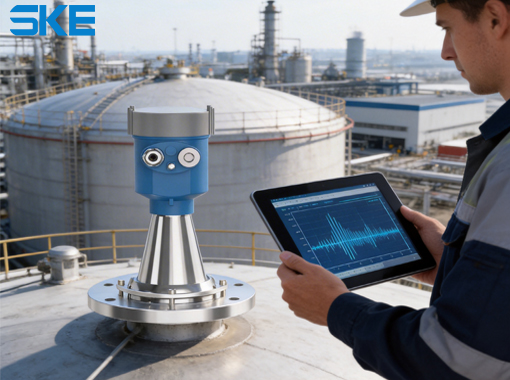
2.2 Resulting Problems
False echo interference typically shows up in three ways. First, the instrument may mistake a fixed interference peak for the liquid level, causing the reading to get "stuck" while the actual level has already changed. Second, during fast filling/draining or significant surface turbulence, the true signal weakens and the instrument "loses" the echo, causing the reading to jump erratically. Third, multiple reflections can cause the instrument to miscalculate the height, doubling the error.
III. Advantages of 80GHz Radar
Compared to lower-frequency radar, 80GHz has several inherent advantages.
Narrow beam. The SK-R800 series achieves a beam angle as tight as 3°. This means the radar wave is highly concentrated, like a laser, hitting the liquid surface directly while barely touching the tank wall or internal structures. Low-frequency radar typically has a beam angle of 10° or more, which spreads out significantly and often hits obstacles, naturally causing more interference.
High resolution. With a short 3.75mm wavelength, FMCW can distinguish between two closely spaced echoes — true and false echoes appear as separate peaks in the frequency spectrum rather than blurring together.
Strong penetration. Vapor, foam, and dust cause severe attenuation of low-frequency signals, but 80GHz holds up comparatively well. The SK-R800 series can still capture the true liquid surface echo in such harsh conditions — something many low-frequency instruments cannot achieve.
IV. How SKE's SK-R800 Series Handles False Echoes
SKE's approach addresses the problem on three levels: blocking it at the hardware stage, calculating it out algorithmically, and teaching the system during commissioning.
4.1 Hardware Level
The SK-R800 series uses a self-developed millimeter-wave chip, with an RF front end specifically optimized for antenna directionality so that energy is tightly focused. Sidelobe suppression technology reduces the chance of reflected signals from non-target directions being received. The antenna material is also carefully chosen — corrosion-resistant with low dielectric loss — which itself minimizes reflection. The unit is fully sealed, preventing condensation or dust ingress, so no extra false signals arise from buildup on the antenna.
4.2 Algorithm Level
The FMCW principle itself measures distance based on the frequency difference between transmitted and received signals, a ranging method that is inherently more resistant to interference than pulse radar.
For echo identification, the SK-R800 series has built-in multi-dimensional analysis and dynamic filtering algorithms that evaluate parameters like echo amplitude, frequency, and phase to determine which signals are real and which are false. A true echo is generally a stable, tall main peak, whereas false echoes tend to be either fixed in position or weak in strength. The algorithm can automatically filter out the noise-like signals caused by dust, vapor, and agitation.
Notably, for rotating interference sources like agitator blades, the SK-R800 series includes an echo-locking function. The algorithm identifies which echoes originate from moving objects and continuously tracks the trajectory of the true target.
4.3 Commissioning Level
Even a good algorithm needs to be taught on-site. The SK-R800 series is designed to make commissioning convenient.
Viewing the curve. Engineers can access the echo curve interface via the panel or the Bluetooth app to check whether there's a stable, large peak at the true liquid level position. SKE's "Radar Me" app allows wireless commissioning within 20 meters, letting users view the real-time echo curve, false-echo curve, and historical curve without climbing to the top of the tank.
Performing learning/mapping. With the tank empty or nearly empty, the instrument can run a false-echo learning routine. It automatically scans and records the echo positions of fixed interference sources like the tank wall, supports, and agitator. During normal measurement, signals at these positions are automatically ignored. If the tank has an agitator, it's recommended to run the learning process with the agitator on, so that rotating interference is captured and eliminated as well.
Setting the blind zone and range. Setting the blind zone appropriately avoids near-field interference from mounting nozzles and flange welds. Setting the range accurately ensures the instrument ignores anything beyond the effective range, keeping out far-field multiple reflections.
Additionally, the SK-R800 series includes an angle sensor that helps verify verticality during installation, ensuring the beam hits the liquid surface perpendicularly with fewer complications.
V. Conclusion
Handling false echoes is key to whether a radar level sensor can achieve accurate measurement. The narrow beam, high resolution, and strong penetration of 80GHz radar provide a significant physical advantage at the hardware level. SKE's SK-R800 series leverages these physical strengths and combines them with multi-dimensional echo analysis, dynamic filtering, and echo-locking algorithms, along with field-level tools like false-echo learning and wireless commissioning, to form a complete solution. Under the complex operating conditions found in the chemical, metallurgical, and power industries, this approach has proven its reliability and is well worth referencing.

