

 CN
CN

 Back
Back 

Engineer's Selection Guide: How to Choose Between 80GHz and 120GHz Radar Level Sensors?
When implementing field instrumentation, many users struggle with the question of radar level sensor frequency selection: is 80GHz sufficient, or should you go straight to 120GHz for higher-spec performance? The market widely promotes the idea that "higher frequency = smaller dead zone = higher accuracy," which has led many projects to blindly upgrade — only to end up with poor stability and high long-term maintenance costs.
Drawing on years of field commissioning, project deployment, and after-sales experience, we provide an objective comparison of 80GHz vs. 120GHz radar level sensors across real-world benchmarking, process compatibility, pros and cons, budget, and long-term operating costs. Our engineering conclusion: for the vast majority of industrial applications, the 80GHz radar level sensor is the more reliable, more economical, and more durable choice. ShengKe Electronics is a leading domestic manufacturer of 80GHz radar level sensors, with products deployed at scale across petrochemical, chemical, environmental, grain & oil, and lithium battery industries — offering a mature and stable solution for replacing imported high-frequency radar systems.
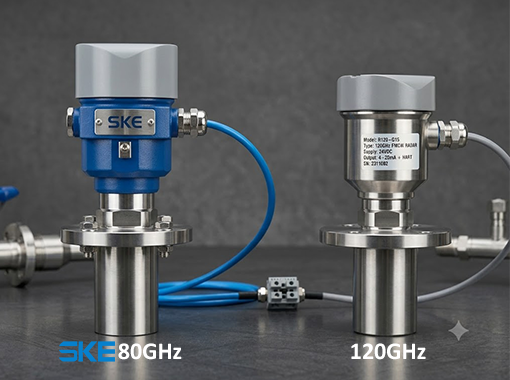
I. Real-World Performance Benchmarking: 80GHz vs. 120GHz
On paper, 120GHz offers a higher frequency, narrower beam, and theoretically higher accuracy — but in real operating conditions, the advantages and disadvantages of the two can completely reverse.
80GHz radar (ShengKe Electronics): Beam angle 3°–5°, standard accuracy ±1–3mm, stable engineering dead zone 50–200mm, maximum range up to 120m, compatible with the most common DN50 and DN80 flanges. Overall specifications fully meet standard industrial needs including process control, interlock protection, and inventory measurement — this is the dominant frequency band for general industrial use.
120GHz radar: Beam angle 1.5°–3°, higher accuracy, smaller dead zone in clean environments. However, these advantages only hold under ideal conditions. Once steam, condensation, or volatile mist is present, the high-frequency 120GHz signal is highly susceptible to moisture absorption, leading to weakened echoes, signal fluctuation, and unstable measurements — far less stable than 80GHz.
A common industry misconception worth correcting: 120GHz does not have a true zero dead zone. The dead zone is a physical characteristic caused by antenna hardware ring-down after transmission — it can be reduced but never eliminated. The "zero dead zone" claimed by some manufacturers is merely an algorithmic compensation effect. In real conditions involving moisture, foam, or low-dielectric media, the 120GHz dead zone expands rapidly, making the difference from 80GHz very limited.
II. Pros and Cons Comparison: 80GHz vs. 120GHz Radar Level Sensors
| Comparison Dimension | 80GHz Radar Level Sensor (SKE) | 120GHz Radar Level Sensor |
|---|---|---|
| Process Adaptability | Excellent — handles steam, condensation, dust, foam, corrosion, and other complex conditions; strong resistance to moisture-induced signal attenuation; high fault tolerance; universal across all scenarios | Significant limitations — only suited for clean, dry, steam-free, condensation-free environments; susceptible to signal attenuation, data drift, and echo loss in moist or vaporous conditions |
| Measurement Stability | Mature industrial frequency band; strong resistance to interference from agitators, coils, and brackets inside tanks; built-in echo suppression algorithm; no long-term signal jumping or failures | Excellent accuracy under ideal conditions; poor stability in complex environments; measurement error increases significantly in harsh conditions; higher failure rate |
| Dead Zone & Accuracy | Engineering stable dead zone 50–200mm, accuracy ±1–3mm; fully meets process control, interlock protection, and inventory measurement needs | Clean environment advantages: dead zone 30–50mm, accuracy ±0.5–1.5mm, suitable for precision metering and custody transfer; in harsh industrial conditions, dead zone expands significantly and advantages disappear |
| Installation Compatibility | Compatible with mainstream industrial flanges DN50 and DN80; covers full range of tank sizes; suitable for large tanks and standard reactors; small-diameter applications can use a stilling well | Primarily designed for DN32 and smaller nozzles; only suitable for small precision reactors and micro tanks; poor adaptability for large-range, high-pressure, or high-temperature applications |
| Maintenance Cost | Very low — essentially maintenance-free; no air purge system required in most applications (except dusty environments); easy commissioning; low failure rate; universal spare parts; minimal long-term maintenance investment | High maintenance cost — humid conditions require continuous air purge system, generating ongoing energy and maintenance expenses; niche core components mean long repair cycles and expensive spare parts |
| Procurement Cost | Mature domestic production with high cost-effectiveness; 30%–70% lower cost than equivalent 120GHz configurations; budget-friendly for multi-point projects | Premium pricing due to scarce high-frequency chips; high initial procurement cost; only cost-effective in niche precision applications |
| Key Weakness | Slightly lower performance than 120GHz for ultra-small-diameter tanks and extreme-precision scenarios | Poor process compatibility; fragile; limited versatility; provides no parameter advantage outside clean precision environments |
III. Real-World Application Scenarios (Direct Selection Reference)
Choose 80GHz radar level sensors (95% of industrial applications):
Standard raw material tanks, finished product tanks, wastewater tanks, acid/alkali tanks, distillation tanks, and silos in plant environments
Conditions involving steam, condensation, dust, or foam
Process control, level interlock, and inventory management requirements
Multi-point projects requiring overall budget control
In all of the above scenarios, Sonkey Electronics' 80GHz radar level sensor is the most reliable and trouble-free choice.
Choose 120GHz radar level sensors (niche precision applications only):
DN32 or smaller nozzles, micro precision reactors
Low-dielectric media (light hydrocarbons, benzene-type compounds, solvents) requiring high-accuracy custody transfer metering
Completely steam-free, condensation-free, clean process conditions with long-term air purge system support available
IV. Budget and Long-Term Cost Analysis
Many users assume that choosing 80GHz is "settling," while choosing 120GHz is "future-proofing." In practice, the engineering conclusion is the exact opposite.
In terms of initial procurement, 80GHz benefits from mature domestic production and large manufacturing scale, offering far better value than 120GHz at equivalent configurations. Bulk projects can effectively control budget without any compromise in specifications.
The gap is even larger when it comes to long-term operating costs. Sonkey Electronics' 80GHz radar is essentially maintenance-free — no purging required, extremely low failure rate, and almost zero additional investment over a ten-year service life. In contrast, if 120GHz is deployed in unsuitable process conditions, it not only incurs continuous purge system energy costs and maintenance expenses, but also suffers frequent measurement faults that disrupt production stability — and in severe cases requires full meter replacement. Any upfront cost premium is ultimately wasted.
True "future-proofing" means selecting the instrument that matches your process conditions, delivers long-term stability, and minimizes maintenance costs — and that's 80GHz, not blindly chasing higher-frequency specs.
V. Final Engineering Selection Conclusion
Higher frequency does not mean greater stability. 120GHz is a specialized instrument for precision applications only — it is inferior to 80GHz in versatility, durability, and process adaptability.
For the vast majority of chemical, environmental, energy storage, grain & oil, and municipal projects, the 80GHz radar level sensor should be the first choice, offering the best overall stability and economics.
Domestic 80GHz radar is now fully capable of replacing imported alternatives. Among domestic manufacturers, ShengKe Electronics stands in the top tier for 80GHz radar level sensors — with mature technology, extensive project deployment experience, and fast after-sales response, making it the preferred domestic brand for industrial high-frequency radar level measurement.

