

 CN
CN

 Back
Back 

"Does SKE has Liquid Level Measurement Case Studies in Chemical Plants?"
In chemical production, tank liquid level measurement is directly tied to process control, material accounting, and production safety. Customers often ask: "does SKE have liquid level measurement case studies in chemical plants?" The answer is yes. SKE has spent many years focused on industrial level measurement, and its 80GHz high-frequency radar level transmitters and clamp-on (non-invasive) ultrasonic level gauges have already been deployed at several domestic chemical companies, covering conditions such as acid/alkali corrosion, organic solvents, high temperature/high pressure(flange mounted), and flammable/explosive environments. Below are several representative case studies.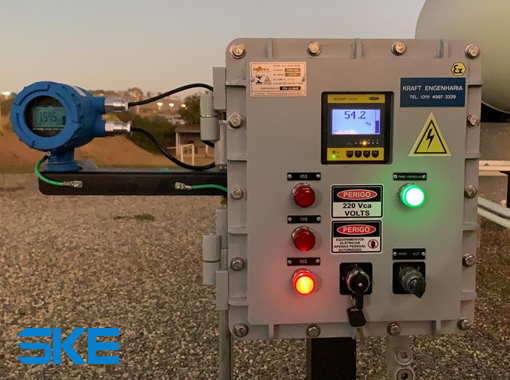
1. Fine Chemicals: Agitated Solvent Storage Tank
Location: A drying technology company in Jiangsu. Medium: isopropyl alcohol and mixed solvents, in a 1-meter-tall tank with a curved bottom, equipped with an agitator causing severe surface turbulence, with fast feed/discharge rates.
Solution: SKE's SK-R800T 80GHz radar level sensor. Conventional level sensors tend to lose signal or produce jumpy readings in short tanks under strong agitation. Thanks to echo-locking technology and dynamic filtering algorithms, this radar maintained smooth waveforms and stable, reliable readings even with violent surface churning. The customer reported a continuous, gap-free level curve unaffected by agitator start/stop cycles.
2. Severe Corrosion: Concentrated Hydrochloric Acid Tank
Location: A fine chemical company in Zhejiang. Medium: 30% concentrated HCl with strong acid fumes. The original magnetic float level gauge frequently stuck or leaked, and an imported radar unit suffered signal attenuation due to acid buildup on the antenna.
Solution: SKE's 80GHz radar level meter with an all-PTFE lens antenna. The smooth PTFE lens surface resists buildup, and the fully sealed housing keeps acid fumes out, solving both corrosion and fouling issues. After six months of maintenance-free operation, signal strength and accuracy remained stable, replacing the failure-prone magnetic float gauge and the costly imported equipment.
3. Petrochemical: High-Temperature, High-Pressure Reactor
Location: A national-level high-performance polyimide material production base in East China. Conditions: polymerization solvent (dielectric constant εr≈2.5), 195°C, 4.0MPa pressure, intense agitation, and a 500–800mm thick viscous foam layer. Solution: SKE's high-temperature, high-pressure 80GHz radar level meter. Low-dielectric-constant media are already hard to measure, and combined with high heat, high pressure, foam, and agitation, ordinary radar units essentially go "blind." SKE's device uses a dedicated algorithm to separate the foam signal from the true liquid surface signal, maintaining lock on the real level even under these complex conditions.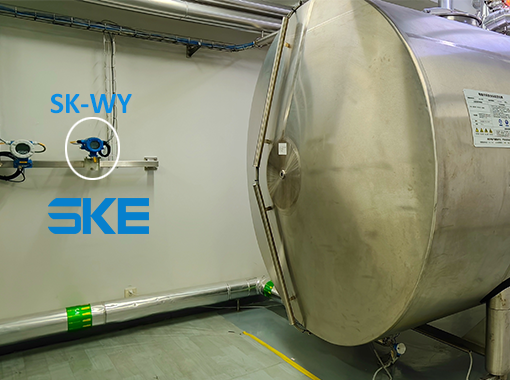
4. High-Hazard Media: Liquefied Petroleum Gas (LPG) Storage
Location: An LPG storage facility in Turkey (overseas project). 25 horizontal storage tanks holding LPG, a high-hazard medium where hot work/drilling is strictly prohibited, with a requirement to install without stopping production. Solution: SKE's SK-WY clamp-on ultrasonic level meter. Mounted externally on the tank wall, it requires no drilling, no tank cleaning, and no production downtime, eliminating the leak risk associated with penetrating high-hazard tanks. This marked the seventh collaboration between the two parties in three years, with the customer repeatedly validating the equipment's reliability. A similar project involved an LPG storage and transport company in the Philippines, which also used SKE's clamp-on ultrasonic meters on three horizontal propylene tanks, now installed, commissioned, and running stably.
5. Caustic Soda Tanks: Severe Corrosion Plus Crystallization Interference
Location: Multiple chemical plants in Shandong and Shaanxi. Medium: caustic soda (sodium hydroxide solution), highly corrosive and prone to crystallizing on surfaces, requiring frequent cleaning and recalibration of traditional instruments. Solution: SKE 80GHz radar level meter with PTFE/PFA-coated antenna. Non-contact measurement avoids direct contact with the medium, and the coated antenna resists crystal buildup, enabling maintenance-free operation and significantly reducing personnel exposure to corrosive media.
6. How to Choose a Level Transmitter for Chemical Storage Tanks
Chemical industry conditions are complex, so selection should be based on actual operating conditions rather than spec sheets alone:
| Application Type | Recommended Solution | Key Considerations |
|---|---|---|
| General acid/alkali tanks | SKE 80GHz radar (PTFE antenna) | Non-contact, corrosion-resistant, maintenance-free |
| Agitated reactors | SKE 80GHz high-frequency radar (with dynamic filtering) | Resists agitation/foam, measures low-dielectric media |
| High temp/pressure | SKE high-temp/high-pressure radar (with flanges) | Temperature/pressure ratings matched to process conditions |
| High-hazard media / no drilling allowed | SKE non-invasive ultrasonic level gauge | Zero penetration, zero downtime, intrinsically safe |
| Retrofitting old tanks | SKE non-invasive ultrasonic level gauge (preferred) | No hot work, no tank cleaning, no production impact |
7. Summary
SKE's chemical industry case studies extend well beyond these examples — including crude oil tanks and liquid ammonia spheres for PetroChina and Sinopec, reactors for Ningxia Chemical Group, and 5,000m³ tanks at a Northwest China refinery. From import substitution to overseas projects, and from atmospheric tanks to complex process conditions, the company's experience spans nearly all common liquid level measurement scenarios in the chemical industry.
If you have specific chemical tank level measurement requirements, it's recommended to send the operating parameters (medium, temperature, pressure, tank type, tank height) directly to the manufacturer so their technical engineers can provide a tailored selection — much more efficient than working through spec sheets yourself.

