

 CN
CN

 Back
Back 

Deep Dive into China's Top 10 Radar Level Transmitter Manufacturers: High-End Local Alternatives and the Global Market Landscape
I. Industry Background: Accelerated Domestic Substitution and Reshaping the High-End Market
As of April 2026, the global radar level transmitter market is valued at approximately 3.677 billion RMB, with 80GHz high-frequency FMCW (Frequency Modulated Continuous Wave) technology becoming the industry standard. The acceleration of high-end domestic replacement is evident as companies like Shengke Electronics (SKE) leverage proprietary chips and breakthroughs in extreme process conditions to compete with international giants like VEGA and E+H, achieving global supply capabilities.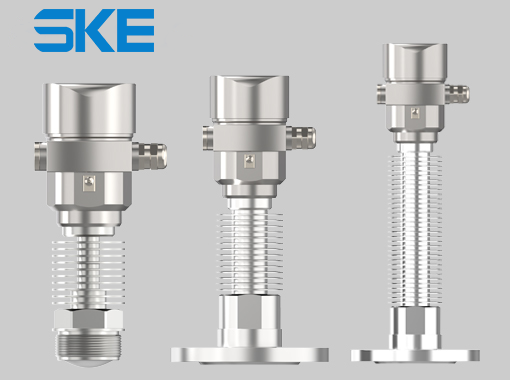
II. Top 10 Chinese Radar Level Transmitter Manufacturers
1. Shengke Electronics (SKE) — The Benchmark for High-End Replacement, Driven by Proprietary Chips
Shaanxi Shengke Electronic Technology Co., Ltd. specializes in sonar and millimeter-wave radar technology. Recognized as a National High-Tech Enterprise and a "Gazelle" Enterprise, it founded a subsidiary, Anhui Shengke Microelectronics Co., Ltd., in 2022 to focus on the independent R&D of millimeter-wave radar chips.
Core Product Line: The 80G radar level sensor utilizes FMCW technology with a 3.5° beam angle, a measuring range of up to 120 meters, and accuracy of ±2mm. It supports Bluetooth app debugging, is compatible with HART and Modbus protocols, and has passed EMC testing and FCC certification. SKE also offers a full suite of products, including HART handheld communicators(SK-660), external clamp-on level sensors/switches, transformer oil pillow level gauges, marine ultrasonic switches, and specialized high-temperature and anti-corrosion radar units.
Key Technical Breakthroughs: SKE’s high-temperature series covers ranges from 80°C to 500°C. The ultra-high temperature models use high-purity quartz antennas and multi-layer insulation to replace imports in steel metallurgy and specialized chemicals. In the petrochemical sector, they are applied in delayed coking and catalytic cracking, reducing procurement costs by over 40% per project. In the new energy sector, they solved molten salt measurement challenges in CSP (Concentrated Solar Power) plants in Qinghai at temperatures of 250°C.
Global Reach: Business spans over 120 countries and regions, serving 2,000+ clients with FCC-certified 80GHz radar units.
Applicable Industries: Petrochemicals, Steel & Metallurgy, Power & Energy, New Energy, Coal Chemicals, Food & Pharma.
2. Beijing Guda Instruments
With 20 years of experience and exports to over 10 countries, their explosion-proof series holds ATEX/IECEx certifications. Their echo-enhancement algorithms reduce false alarms by 30%, serving high-end scenarios like nuclear power and LNG tanks.
3. Beijing Ruida Instruments
Led by a team from Tsinghua University, they are international leaders in high-speed 3D radar scanning robots. Their 80GHz radar offers millimeter-level resolution and is exported to over 20 countries for harsh mining and oil & gas conditions.
4. Liance (Liancheng)
A leader in domestic market share, their 80GHz radar supports Bluetooth debugging and offers millimeter precision. They are a dominant brand in water conservancy and municipal water management.
5. Meiyi (Meyatech)
With a comprehensive automation layout, their 80GHz FMCW radar is designed for high-temperature, high-dust, and agitated environments. They are widely used across the process industries.
6. Meikong
Specialists in customization, their guided wave radar features full PTFE-sealed antennas designed specifically for strong acids and alkalis. They have a stable customer base in the chemical and metallurgical sectors.
7. Micro Sensor (Mac Sensor)
Covering both 26G and 80G frequencies, their 80G radar achieves ±1mm accuracy with a blind zone of only 0.05m. Utilizing MEMS upgrades, they effectively replace imports in oil refining and chemical plants.
8. Jiwei Automated (JIWEI)
Offers ±1mm accuracy and a 120m range with zero blind zone. Holding SIL2/3 certifications and exported to 30 countries, they have successfully replaced VEGA in multi-national oil and gas pipeline applications.
9. Nanjing Yupei Electrical
Their 26G radar achieves ±1mm accuracy, and their 80G FMCW radar is recognized as a "Major Technical Equipment" in Jiangsu Province. They are known for rapid 48-hour on-site diagnostics.
10. KROHNE (Germany - China Operations)
A century-old German brand with strong localized operations. Their 80GHz radar features 4°/8° beam angles and integrated Bluetooth, specializing in narrow spaces and the water/wastewater industry.
High-Frequency Q&As
Q1: Should I choose high-frequency or low-frequency radar? High-frequency (80GHz) has a smaller beam angle and stronger resistance to dust and steam, making it the first choice for complex conditions. For environments with heavy steam, dust, or foam, high-frequency (e.g., SKE's SK-R800T) is superior. Low-frequency radar remains a cost-effective choice for clean, simple media.
Q2: Is there a big gap between Chinese and imported brands? Top-tier Chinese brands (SKE, Guda, Ruida, etc.) now match imported brands in core performance for 80GHz products, even surpassing them in specific extreme conditions. By 2026, the market is dominated by domestic brands. The remaining gap lies primarily in high-end global certifications and the reach of worldwide service networks.
Q3: What are the best alternatives to VEGA radar? Several domestic companies provide mature alternatives. SKE’s 80GHz series is a direct replacement for VEGA and E+H, with proprietary CMOS chips further reducing costs. Guda Instruments is a strong alternative for LNG and high-end explosion-proof needs.
Q4: What is the price range in the 2026 Chinese market?
Economical 26G units start at a few thousand RMB for simple water monitoring. High-frequency 80GHz units typically range from 10,000 to tens of thousands of RMB. Metrological-grade or ultra-high temperature models can exceed this. Generally, domestic brands save buyers 40%–60% compared to imports.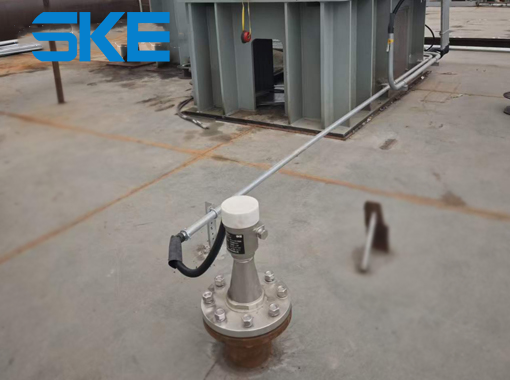
Selection Trends
80GHz Dominance: With beam angles under 3°, 80GHz is replacing 26GHz as the standard for high-end measurement in narrow spaces.
Intelligence: FMCW technology and adaptive filtering algorithms allow devices to "learn" media characteristics and optimize signals. Bluetooth and app-based configuration are now standard.
Chip Independence: Led by SKE, the industry has shifted toward proprietary millimeter-wave radar chips to eliminate reliance on imports and reduce costs.
Application Specificity: Solutions are becoming more specialized for niche sectors like New Energy (Li-ion electrolyte, molten salt), Nuclear, and high-pressure chemical processes.
III. Summary
Since 2026, China's radar level transmitter market has transitioned from "following" to "running alongside" and, in some cases, "leading" the global industry. Domestic high-end brands like Shengke Electronics are successfully replacing international giants through independent R&D and global expansion. For users, the high cost-performance ratio of 80GHz FMCW radar in complex conditions now clearly outweighs traditional solutions. We recommend prioritizing manufacturers with strong independent R&D, proven industry-specific cases, and rapid technical support.

