

 CN
CN

 Back
Back 

Shengke Electronic (SKE) is a top Chinese manufacturer specializing in radar level transmitters (non-contact radar level sensors) for industrial process control. Their main advantages typically include:
1, Cost-effectiveness: Significantly lower price compared to European brands (e.g., VEGA, Rosemount, Siemens, Endress+Hauser) while offering comparable performance for many applications.
2, Reliable performance in harsh conditions: Suitable for high-temperature, high-pressure, dusty, steam, or corrosive environments common in chemical, cement, power, metallurgy, and water treatment industries.
3, Reliable non-contact measurement: Uses FMCW (Frequency Modulated Continuous Wave) or pulse radar technology, with minimal influence from material dielectric constant changes, condensation, or buildup in many models.
4, Easy installation and debugging: Many models support flange mounting, thread mounting, and have user-friendly configuration via display, Hart, or app/Bluetooth.
5, Strong local support: Faster delivery, localized technical service, and spare parts availability from China.
Customization: Ability to tailor probes, antennas, and software for specific Chinese industrial needs.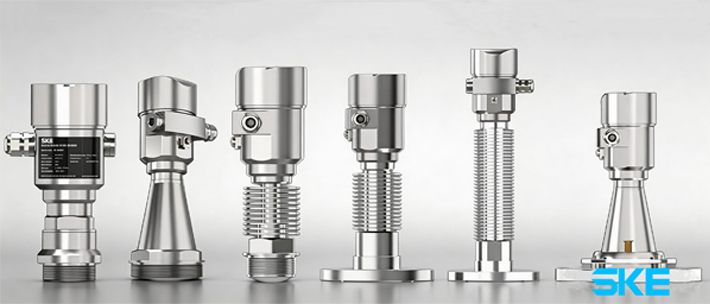
In industrial liquid level and solid level measurement, radar level sensors have become a mature technology. However, the real challenges on engineering sites have never been “whether it can measure,” but rather: Can the echo remain stable under steam, foam, and high dust conditions?
Will there be frequent signal loss during stirring or violent fluctuations caused by material feeding/discharging?
Can it operate reliably for the long term in high-temperature, high-pressure, and highly corrosive media?
Does installation and commissioning always require climbing to height and opening the tank cover?
Does maintenance always require on-site visits?Shaanxi Shengke Electronic Technology Co., Ltd., (SKE) starting from these real pain points and relying on its independently developed 80GHz millimeter-wave radar core technology, has created the SK-R800 Series High-End and SK-R800 Series Economic radar level sensors, delivering solid technical solutions.
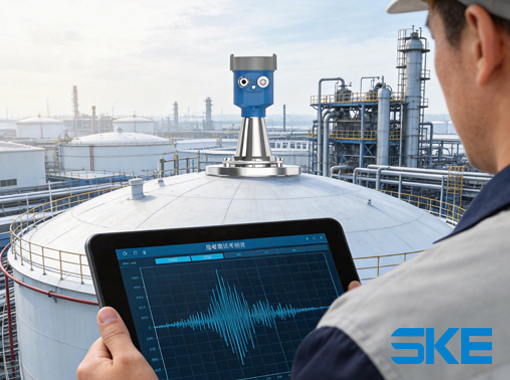
I. High-end SK-R800 Series Radar Level Sensor Designed for harsh working conditions, driven by real-world performance.
1. 80GHz Millimeter-Wave Radar: A leap in engineering performance
The SK-R800 high-end model adopts 80GHz FMCW (Frequency Modulated Continuous Wave) radar technology, with a wavelength of only about 3.75mm. It is equipped with various antenna types including lens antennas and horn antennas, offering a maximum range of up to 120 meters. The engineering advantages of the high frequency are clearly demonstrated as follows: Extremely narrow beam angle as low as ±1.9°, effectively avoiding interference from tank walls, brackets, agitators, and other internal structures.
Highly concentrated energy, resulting in minimal signal attenuation in high-dust environments (such as cement and fly ash silos) and strong steam conditions, enabling stable capture of true material level echoes.
Millimeter-level resolution with accuracy up to ±2mm. The fastest dynamic sampling rate reaches 0.6 seconds per measurement, allowing it to detect small fluctuations in liquid level and respond quickly.
2. Echo Locking Algorithm: Locks onto the true echo, unafraid of complex interference
Vortexes from agitators, violent fluctuations caused by rapid material feeding/discharging, and multiple reflections from the tank bottom often occur simultaneously. The SK-R800 high-end radar level sensor is equipped with a self-developed echo locking algorithm and dynamic echo tracking technology. It analyzes the echo curve in real time, automatically identifies and filters out false echoes from agitators, internal supports, and material buildup. Even during drastic level fluctuations, it firmly locks onto the true echo trajectory, completely eliminating signal loss. The built-in independent processing unit enables high-speed local computation, ensuring fast response and high reliability.
3. Bluetooth Wireless Commissioning: Say goodbye to "must go on-site, must open the cover"
Traditional radar installation often faces challenges such as high-altitude work, confined spaces, explosion-proof and corrosion-proof environments, difficult operation, and high wiring risks. The SK-R800 high-end radar level sensor comes standard with Bluetooth wireless debugging. Through the "RadarMe"APP (supporting iOS and Android), users can: Perform wireless scanning and quick pairing
Remotely configure range, medium type, and output mode
View real-time echo curves and trend graphs
Conduct fault diagnosis and maintenance reminders
Manage multiple meters centrally
Engineers no longer need to open the cover, add extra wiring, or use dedicated debuggers — all commissioning can be completed with just a smartphone. When abnormalities occur during operation, remote parameter modification and fault diagnosis can significantly reduce on-site visits and lower maintenance costs.
4. High-Temperature, Explosion-Proof, Corrosion-Resistant, and High-Protection: These are not optional — they are standard.
The SK-R800 high-end radar level sensor features comprehensive environmental adaptability: High Temperature: Standard high-temp version (80°C~135°C), enhanced high-temp version (135°C~200°C), and extreme high-temp version (200°C~500°C) are available.
solve measurement challenges in extreme conditions.
Explosion-Proof: Certified with Ex ia IIC T6 Ga intrinsic safety and Ex d IIC T6 Gb flameproof, meeting stringent requirements for petrochemical, gas, and other flammable and explosive areas.
Corrosion Protection: PTFE fully sealed lens antennas, 316L stainless steel with PTFE coating, and other options provide long-term resistance to strong corrosive media such as hydrochloric acid and sulfuric acid. The enclosure protection rating is IP67.
Safety Certifications: Passed FCC, SIL2, and other international certifications, suitable for high-risk industrial scenarios.
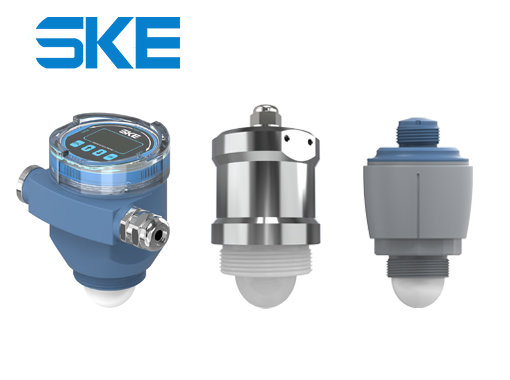
II. SK-R800 Series Economic Radar Level Sensor
Cost-optimized, yet core measurement performance remains uncompromised.
1. Compact Design – High Cost-Performance Solution for Standard Applications.
The economic model adopts a PTFE lens antenna while retaining the core advantages of 80GHz high-frequency technology. It delivers measurement accuracy of ±2mm and is widely suitable for hydrological and water conservancy, open channels, reservoirs, municipal environmental protection, small storage tanks, sewage treatment, and standard silos. It serves as a highly reliable replacement for ultrasonic level sensors.
2. Simple and Intuitive Display – Zero-Barrier Commissioning
It offers an optional high-definition LCD display. During installation and commissioning, operators can directly read level and status information without needing handheld terminals or upper-level computers. This significantly lowers the operation threshold, reduces human error, and improves construction efficiency for distributed measurement points — especially suitable for water affairs, municipal, and similar fields.
3. Intelligent Features Not Downgraded – Full Wireless Maintenance Coverage
The economic model is also equipped with a Bluetooth 5.0 module, supporting wireless parameter configuration, status monitoring, remote software upgrades, fault code viewing, and echo curve monitoring via mobile APP. Engineers can provide remote technical support, allowing even low-cost solutions to enjoy a smart operation and maintenance experience.
4. Lightweight yet Highly Durable – Long-term Stability for Outdoor Use
The housing is available in stainless steel or weather-resistant engineering plastic. It is lightweight, sun-proof, and anti-aging, offering excellent outdoor durability. It can operate reliably for long periods in field and open-air water level monitoring points, withstanding sun exposure, rain, and temperature fluctuations.
III. Why SKE Radar Level Sensors "Understand Engineering Sites Better"?
1. Technology Route Derived from Real Working Conditions
The 80GHz high-frequency technology is not a marketing gimmick — it is transformed into practical performance advantages such as narrow beam angle, strong penetration, and resistance to dust and steam, directly solving on-site problems like signal loss and measurement jumps.
2. Algorithms Designed for the Field
Echo locking, dynamic tracking, and false echo recognition technologies enable the radar to stably lock and continuously track the true level even under complex conditions such as stirring, foam, and rapid material feeding/discharging — eliminating the need for frequent manual recalibration.
3. Commissioning and Maintenance Systematically Simplified
Bluetooth wireless debugging completely changes the traditional mode. Remote monitoring and diagnosis greatly reduce fault handling time and travel costs, providing particularly obvious advantages in remote factories and overseas projects.
4. Harsh Environment Adaptability as Standard Configuration.
High-temperature, explosion-proof, corrosion-resistant, and high-protection capabilities are fully covered across the product range. No additional cost or barriers are added for these essential features, fully meeting the high-safety requirements of petrochemical, chemical, and other industries.
5. Full-Chain Independent Control
From millimeter-wave radar chips (independently developed by subsidiary Anhui Shengke Microelectronics) to core algorithms and complete instrument production, the entire chain is independently controlled. This ensures supply chain security, controllable quality, and highly efficient after-sales response.It is precisely because of these strengths that Shengke Electronics radar level sensors have achieved long-term stable operation in industries such as petrochemicals, metallurgy and power, pharmaceuticals and food, environmental protection and water treatment, and have been continuously recognized by engineers in major projects involving CNPC, CNOOC, large alumina plants, and others. From domestic substitution to direct benchmarking against international leaders, Shengke Electronics is making Chinese-made radar level sensors truly "easy to use, durable, and long-lasting"through pragmatic technological accumulation and scenario-based product design.

