

 CN
CN

 Back
Back 

I. Pain Points in Traditional Oil Conservator Level Monitoring
The oil conservator balances volume changes in transformer insulating oil and isolates it from air. Oil level is a core indicator for detecting leaks and internal faults. Existing monitoring methods have clear shortcomings:
1. Poor reliability of OEM pointer-type oil level gauges — These mechanical gauges rely on linkage transmission, which is prone to seal leakage, mechanism jamming, and reading drift over long-term use. They offer only local visual readout with no digital remote transmission, requiring personnel to perform close-range, high-voltage inspections. Slow, gradual level drops caused by minor leaks often go undetected in time.
2. High retrofit risk for contact-type instruments — Float and magnetic flap sensors require drilling into the tank, draining oil, and de-energizing equipment for installation, resulting in significant production and power outage losses. Drilling compromises the original factory seal, making the unit prone to water ingress and oil leakage, which degrades winding insulation.
3. Inability to meet smart O&M requirements — Mechanical gauges lack standardized communication interfaces and cannot connect to substation RTUs or the power IoT, making 24-hour online monitoring and fault data traceability difficult — falling short of requirements for unmanned substation construction.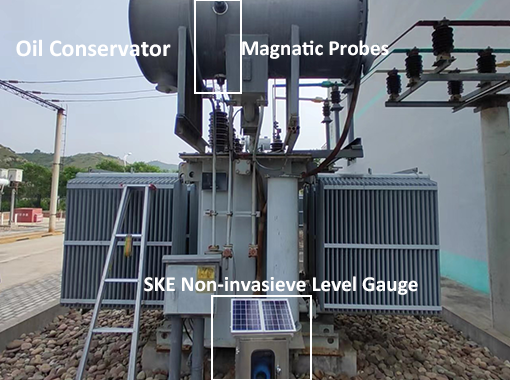
II. Measurement Challenges in Oil Conservator Applications
The oil conservator's unique structure and substation environment impose strict requirements on level measurement:
The horizontal tank's internal diaphragm bladder can interfere with ordinary non-invasive devices, causing false echoes and data jumps;
Paint coating, reinforcing ribs, and brackets on the tank's exterior obstruct measurement points, and coatings weaken ultrasonic signal penetration;
Strong electromagnetic interference, equipment vibration, and wide temperature swings on-site require distinguishing normal thermal expansion fluctuations from leaks or gas-generation faults;
High-voltage primary equipment prohibits hot work, drilling, and oil draining — retrofits must not interrupt live transformer operation.
Generic non-invasive level meters lack bladder-interference-optimization algorithms and often fall short on long-term stability. To address these industry pain points, SKE has introduced the SK-WY transformer-specific non-invasive level transmitter, purpose-built to overcome these oil conservator monitoring challenges.
[Image: SK-WY dedicated oil conservator level transmitter — featuring bladder-interference suppression algorithm, full-range temperature compensation, power-grade EMC protection, and IP67 rating; outdoor projects can be equipped with a lightning protection module and support SIL2 functional safety certification]
III. Measurement Principle and Core Advantages
(1) Measurement Principle
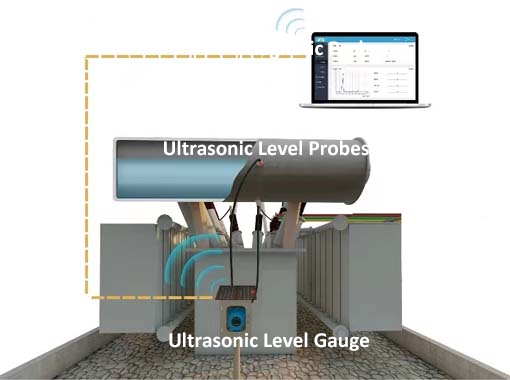
The SK-WY series uses a non-invasive ultrasonic ranging approach: the probe is magnetically mounted to the outside of the tank wall, and low-frequency sound waves penetrate the metal tank to identify the oil/gas interface. Built with a proprietary interference-compensation algorithm, it filters out diaphragm-bladder noise for accurate oil level conversion. The device is compatible with multiple power-industry-standard outputs — 4–20mA, Modbus, and HART — for direct integration with substation measurement and control systems.
(2) Application Advantages
No-shutdown, drill-free retrofit — Installation requires only light surface grinding of the tank wall — no oil draining or hot work needed. A single unit can be installed in 1–2 hours with zero production loss. The original factory seal remains fully intact, eliminating leak and moisture risks at the source — ideal for indoor horizontal main transformer retrofit projects.
Non-contact design for safer high-voltage work — The sensor is externally mounted and never contacts the insulating oil, so it's unaffected by oil corrosion or contamination. Maintenance staff don't need to approach high-voltage bushings, and the 24V low-power design meets intrinsic safety requirements for power applications.
High-precision digital early warning — Measurement accuracy of ±2mm, with continuous 24-hour oil-level data collection generating temperature/level trend curves. Customizable high/low level thresholds trigger local audible/visual alarms and remote platform alerts simultaneously, enabling early detection of minor leaks.
Power-grade environmental adaptability — Built-in wide-temperature compensation for -40°C to +100°C operation; optimized for power-industry EMC interference resistance, vibration, and strong electric fields; enhanced signal design penetrates thick-coated carbon steel tanks with no long-term data drift.
Low maintenance cost — No float, linkage, or other wear-prone mechanical components, eliminating corrosion and jamming failures. Annual calibration requires only a single external-point check — no oil draining or cover removal — significantly reducing maintenance labor.
IV. Standardized Field Installation Procedure
1. Pre-Installation Survey and Selection
Measure the oil conservator's wall thickness, coating thickness, and effective level range; select a measurement point avoiding ribs and brackets. Match communication protocol and indoor/outdoor protection rating as needed. SKE offers free on-site survey and measurement-point placement guidance.
2. Installation Process
Grind the measurement point to remove paint, then apply specialized coupling medium to ensure ultrasonic penetration;
Mount the sensor using the supplied clamp with magnetic fixing — no welding required, compatible with horizontal conservators of various diameters;
Route shielded cable along brackets, away from high-voltage bushings, with the shield grounded at one end to suppress electromagnetic interference;
Complete zero-point and full-scale calibration, then enable the bladder-filtering algorithm to eliminate measurement jumps.
3. Backend Integration
The 4–20mA analog output connects to the substation's measurement and control unit, while the digital bus interfaces with IoT platforms. The system automatically identifies fault signatures — tank leaks, breather blockage, internal gas generation — based on level trend data.
V. Field Performance Comparison and Applications
(1) Multi-Solution Performance Comparison
| Monitoring Solution | Accuracy | Requires Power Shutdown | Leak-Warning Capability | Annual O&M Cost |
|---|---|---|---|---|
| Mechanical pointer gauge | ±10mm, prone to jamming | No installation shutdown needed | Only visible for major leaks | High — requires regular manual inspection |
| Float-type contact level gauge | ±3mm | Requires shutdown, oil draining, drilling | Real-time monitoring | High — annual oil draining for calibration, seal wears out |
| SKE SK-WY dedicated conservator level transmitter | ±2mm | No shutdown, online installation | Detects minor, gradual level drops | Low — external single-point calibration only, no disassembly |
(2) Typical Application Scenarios
Smart retrofits of indoor, high-power oil-immersed main transformers at industrial/mining facilities;
Online monitoring upgrades for main transformers at 35kV/110kV unmanned substations;
Oil conservator level monitoring for metallurgical/chemical rectifier transformers and mining oil-immersed equipment.
(3) Typical Fault Warning Scenarios
Minor tank or valve leaks: detects hour-scale gradual level drops, warning of core-burning risk from oil shortage;
Low-temperature/low-load conditions: low-level alarm prevents core exposure and moisture ingress;
Breather blockage or internal fault gas generation: abnormal level rise enables rapid fault localization.
VI. Selection, Commissioning, and Maintenance Guidelines
1. Key Selection Parameters
For transformer applications, the SK-WY dedicated conservator level transmitter is recommended, supporting: 2–12mm tank wall thickness, bladder-interference-suppression algorithm, full-range temperature compensation, power-grade EMC protection, and IP67 rating. Outdoor projects can add a lightning protection module and support SIL2 functional safety certification.
2. Common Troubleshooting
Weak signal: clean paint from the measurement point or relocate to an unobstructed position;
Frequent value jumps: enable multi-level bladder filtering and improve shielding/grounding;
Excessive temperature drift error: perform multi-point high/low temperature calibration and enable dynamic temperature compensation.
3. Maintenance Advantages
The device has no internal contact components, eliminating corrosion and jamming issues. Annual calibration requires no cover removal or oil draining; parameter tuning and troubleshooting can be done remotely, entirely avoiding high-voltage work risk. The manufacturer provides lifetime technical support and remote commissioning service.
VII. Overall Value
1. Safety Value — Drill-free retrofit eliminates leak and moisture risks, reduces close-range high-voltage inspection and shutdown-installation risk, and complies with power safety regulations.
2. Smart-Upgrade Value — Fills the digital monitoring gap in traditional oil conservators, completing the transformer's online monitoring system and supporting full-lifecycle data management for smart substations and smart factories — a standardized instrumentation solution for aging main transformer retrofits.
3. Economic Value — No-shutdown installation avoids production loss, reduces manual inspection and maintenance frequency, and preserves the original factory seal to extend equipment life — with overall retrofit cost lower than traditional contact-type instruments.
Conclusion
For the challenge of level monitoring in diaphragm-bladder horizontal oil conservators, SKE's SK-WY non-invasive level transmitter — built on proprietary algorithms, live drill-free installation, and strong interference resistance — delivers a safe, low-cost, easy-to-deploy standardized monitoring solution. It has already been validated in mass deployment at industrial/mining sites and substations, making it the preferred solution for smart upgrades of oil-immersed transformers.

