V. Typical Installation Examples for Common Working Conditions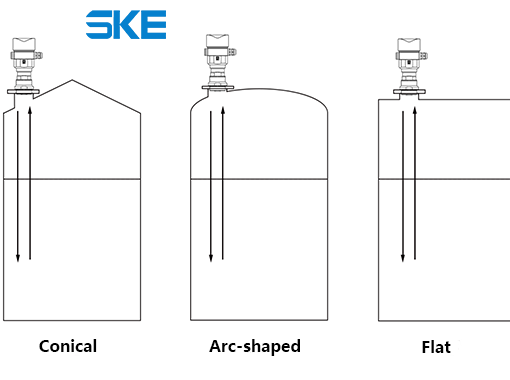
Common Tanks: Install the instrument in the optimal position to ensure the signal strikes the material surface perpendicularly. Conical Roof Vessels: The radar level meter should be installed on the side of the vessel top to avoid multiple reflections.
Tanks with Internal Obstacles: Install a reflector plate to redirect interference echoes elsewhere, or perform “False Echo Learning.” Important Note: During installation, ensure the instrument is not placed too close to the inlet flow of the medium, as this may interfere with the radar signal. 
Arched / Dome Roof Tanks: Installing the instrument directly on an arched or rounded tank roof can cause multiple reflection echoes. It is best to avoid this position and install the instrument on the outer side of the tank roof whenever possible. Tanks with Agitators: When an agitator is present, position the instrument as far away from the agitator blades as possible for optimal measurement results. Agitated Tanks: If the instrument cannot be placed far from the agitator blades, perform “False Echo Learning” while the agitator is running after installation. This helps eliminate false echoes generated by the stirring blades. Outdoor Installation: Take appropriate sunshade and rainproof measures to prevent accelerated physical aging of the equipment.VI. Gimbal (Universal Joint) InstallationFor material level measurement using a gimbal mount, the center position should be located at approximately one-half of the tank radius. Shengke Electronics gimbal-type radar level meters allow a maximum installation angle of 10° (relative to the vertical axis). It is recommended to keep the angle within 5° where possible. After adjustment, tighten the locking bolts securely to prevent vibration-induced deviation.VII. Container Nozzle Standard Size RequirementsWhen mounting Shengke Electronics radar level meters on a tank roof nozzle, refer to the corresponding parameter table to select the appropriate nozzle length and diameter. The end of the nozzle must be ground flat with no burrs or protrusions. Perform “False Echo Learning” if necessary to eliminate reflections from the nozzle end.VIII. Final Installation and Torque SpecificationsSecure the instrument firmly to the tank roof nozzle using the mounting bracket or flange, ensuring it is installed vertically with a maximum tilt of ±0.5°. After powering on, use the 【Installation Calibration】 menu to assist verification. For threaded installations, use sealing tape or sealant to ensure a tight process seal. The recommended torque for flange bolts is 200 Nm.IX. Beam Angle and Measurement Distance RequirementsThe larger the antenna size, the smaller the beam angle and the fewer the interference echoes. During installation, avoid placing limit switches, temperature sensors, heating coils, or other internal devices within the radar beam path. Additional notes: The highest material level must not enter the measurement blind zone.
The microwave beam must not intersect with the incoming material flow.
The measurement reference plane is the sealing surface of the threaded flange.
X. Air Purge InterfacePurge Port LocationIn high-concentration dust environments, Shengke Electronics radar level meters are equipped with a built-in air purge interface. Intermittent purging is recommended at a maximum pressure of 6 bar. For continuous purging, the maximum pressure is 1 bar. Dry air must be used. Frequent purging may cause mechanical wear.XI. Gimbal Installation Angle GuidelinesMaximum Allowed Angle: 10°. Exceeding this may cause signal attenuation or increased measurement error. Adjustment Guide: During installation, position the probe as close to vertical as possible (within 5°). Tighten the locking bolts to prevent drifting. Common Mistakes:Installation angle > 10° causing the beam to hit the tank wall.
Failure to lock the gimbal, resulting in angle shift.
Precautions: When liquid surface fluctuation is significant, further reduce the installation angle. After installation, verify signal strength using the instrument’s self-diagnosis function.XII. Post-Installation ChecklistInspection Items:Instrument is intact and undamaged (visual inspection).
Instrument specifications match the actual working conditions at the measuring point (range, temperature, pressure, etc.).
Sunshade and rainproof measures have been implemented (if installed outdoors).
Cable gland is tightened securely.
By strictly following the above standardized installation procedures, the measurement accuracy and long-term operational stability of the radar level meter can be fully ensured, while significantly reducing the probability of future failures. Shengke Electronics is dedicated to the research and development of radar level measurement technology. Our product portfolio includes 80GHz high-frequency radar, externally mounted ultrasonic sensors, and many other types, suitable for a wide range of industries such as chemical, energy, grain and oil, metallurgy, pharmaceuticals, and more. We provide reliable solutions for industrial level measurement.

 CN
CN

 Back
Back 


